
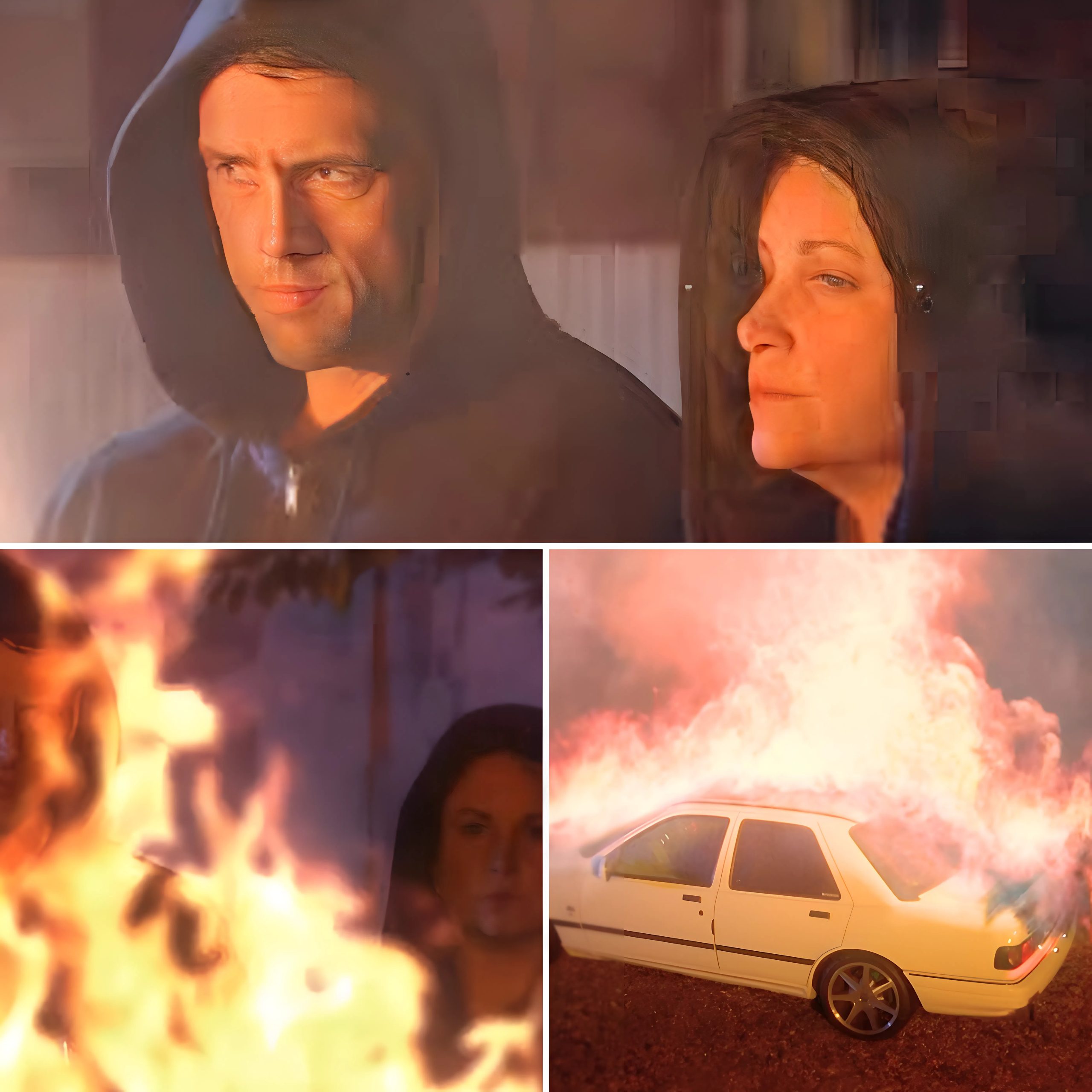
EastEnders- Mark torches Lauren’s car after Sam suggests it to him
The air within the garage is heavy with the suffocating scent of desperation and the metallic tang of impending ruin as Mark finds himself cornered, not just by the lethal shadow of Russell Delaney, but by the insidious, persuasive poison of a new, catastrophic proposal. The conversation, ostensibly about escape and the search for a new start following the fallout of a fatal confrontation, has twisted into a dark masterclass on how to monetize misfortune, as the suggestion of torching their own legitimate inventory becomes the latest, most dangerous gamble in a life already built on the precipice of total collapse. To burn the very “legit motors” that were supposed to be their salvation is a move of pure, nihilistic chaos, a calculated act of arson designed to force Lauren into a corner where her only remaining option is to abandon her integrity and embrace the murky, criminal underworld of “knockoff” motors. The tension between them is visceral, a clash between Mark’s fading, stubborn commitment to a semblance of professional legitimacy and the seductive, destructive logic of an associate who believes that everyone—even the most principled among them—has a price point at which their morality becomes a negotiable commodity. It is a scene of profound narrative dread, where the suggestion of “something more permanent” than a simple disappearance is revealed to be a gateway to a life of perpetual, irreversible criminality, leaving the audience to watch in breathless, horrified anticipation as the final shred of Mark’s agency is eroded by the cold, tactical brilliance of his own, self-appointed mentor in crime.
The manipulation of Lauren’s maternal and domestic vulnerabilities—her need to provide for her “fella” and her “kids”—is the most jarring, predatory aspect of this entire scheme, highlighting how the most intimate details of a person’s life are now being weaponized against them. By positioning the destruction of her business as the only viable path to long-term survival, the proposer is successfully gaslighting Mark into believing that he is not orchestrating her ruin, but actually facilitating her future stability. This is the tragic, age-old irony of the underworld: the belief that by shattering a person’s world, you are merely clearing the debris for a “better” reality that you alone can provide. The dismissal of Mark’s moral hesitation—his insistence that Lauren “would never go for that”—is met with a chilling, intuitive assertion of her hidden, inherited greed, a claim that she is, at her core, just like the “old man” she comes from, and therefore destined to succumb to the lure of the main chance. It is a psychological trap of the highest order, where the victim’s own character is used as the leverage to ensure their compliance, turning every noble instinct of providing for one’s family into a liability that can be exploited, leveraged, and ultimately burned to the ground. As the proposal is laid out in clinical, terrifying detail, the audience is forced to witness the total, heartbreaking surrender of Mark’s common sense, where the desperate need to escape Russell Delaney has overridden every residual scrap of empathy he might have once felt for the woman he is about to betray.
The mention of the “legit motors” versus the “knockoff” market serves as the definitive, structural rot at the heart of their predicament, revealing that their entire professional existence has become nothing more than a series of high-stakes, erratic maneuvers designed to forestall the inevitable collapse of their illusions. The casual, almost flippant analysis of Lauren’s potential descent into the criminal market is a masterclass in the normalization of deviance, where the illegal nature of their future income is treated not as a catastrophe, but as a tedious, logistical necessity that must be overcome to maintain their lifestyle. It is a chilling, visceral display of how quickly the moral center of an individual can shift when the promise of easy, illicit money and the terror of physical liquidation by Russell Delaney collide, leaving them to treat the very concept of “legitimacy” as an adversary to be outsmarted rather than a standard to be met. The suspicion voiced about whether she can “knock them out” is the spark that threatens to ignite the entire powder keg, forcing Mark to realize that he is not merely managing a business, but actively engineering his own soul’s destruction through a series of increasingly transparent, high-stakes lies.
Their conflict is further exacerbated by the crushing, impending reality of Russell Delaney’s reach, a threat that makes the burning of the cars seem like a minor, almost trivial price to pay for the chance to survive another week in the shadows. The refusal to engage in the debate over whether this is “too good to be true” or a path to damnation is a sharp, definitive strike against the tactic of using morality as a shield, proving that for Mark, the survival of his own life has finally eclipsed the sanctity of his professional and personal relationships. The intensity of this realization—that running and running is a doomed strategy when Russell is the one in pursuit—has ignited a long-suppressed, volcanic rage that refuses to be silenced by the nagging voice of his own conscience. He is no longer interested in the “good” life or the prospect of redemption; he is interested only in the restoration of his own safety as a space free from the corrosive influence of a man who has proven, through his lethal reach, that he views everyone as a resource to be plundered, liquidated, or burned. 
Ultimately, as we bear witness to the final, painful erasure of Mark’s moral tether, the audience is left to grapple with the realization that the tragedy here is not the loss of the motors, but the absolute, terminal erosion of the person who was once trusted enough to manage them with pride. The arson is planned, the bet is being orchestrated, and the domestic facade—the life of a legitimate mechanic in a legitimate garage—has been unmasked as nothing more than a strategic, shallow play for time that has finally, irreversibly run out. As the dialogue ends and the final, haunting agreement is reached in the shadows of the workshop, the viewers are left to process the cold, undeniable certainty that the work of destroying Lauren’s life has already begun, and that for the man who has been cast into this web of criminal arson, the path forward is as dark and unprovided for as the illicit, black-market deals he is about to enter. The stage is set for a climax of devastating proportions, and as the dust prepares to settle on the wreckage of their trust, the viewers are left waiting with bated breath to see if they can ever truly reconcile their survival instincts with the cold, hard reality of their defiance, or if they are doomed to repeat the cycle of destruction until there is nothing left to salvage. Their lives, much like the “old motors” they deal in, are breaking down in real-time, and the realization that they can no longer keep the engines running is the most profound, and most necessary, truth they are about to be forced to face, leaving us to watch in breathless, horrified anticipation as the illusion of their stability is finally, and permanently, stripped away.